

Amazon made a lot of announcements at unBoxed 2026. And yes, AI was involved in almost all of them.
…..no surprise there.
But after spending the week on the ground at unBoxed, our team came away thinking the bigger story wasn't simply that Amazon added AI to more products. It's that Amazon is steadily connecting more of advertising, commerce and measurement into one system, and using AI to remove a lot of the manual work in between.
Planning, buying, creative, reporting, measurement and even the shopping experience itself are starting to overlap in ways they haven't before.
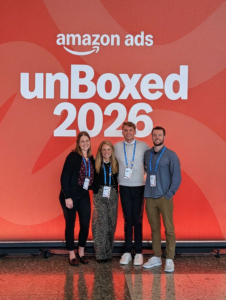
Code3 was at unBoxed 2026 getting a firsthand look at what's coming next. Here are the announcements that stood out to our team, and what marketers should know.
Amazon Ads Agent Wants to Do a Lot More of the Work
Amazon Ads Agent showed up just about everywhere at unBoxed. The conversational AI layer Amazon is building across its advertising platform can help advertisers plan media, find audiences, analyze performance and make campaign changes using natural language.
Our team also saw how Amazon is extending Ads Agent beyond campaign management. In an AI Masterclass at the event, Amazon showed how Ads Agent can surface insights around Brand Store performance and quality and help advertisers move from insight to activation more quickly.
That's where our attention peaked.
Amazon isn't just building another AI assistant that tells you what happened. It increasingly wants Ads Agent involved in not only figuring out what to do next, but also helping you do it. Sounds terrifying, we know. But advertisers aren't required to hand over the keys. Manual controls still exist, and teams can decide how much they want Amazon's AI to handle.
The question going forward won't be whether AI plays a role in managing Amazon advertising. It will be which decisions you automate and which ones are important enough to keep a human behind them.
Full-Funnel Campaigns are Actually Bringing the Funnel Together
Amazon also introduced Full-Funnel Campaigns, bringing sponsored ads, display, video and Streaming TV together in one campaign.
Advertisers provide the products, budget and creative, and Amazon's AI can determine the channel mix, move budget and optimize toward sales growth. If creative isn't available, Amazon's generative AI tools can help fill those gaps, too.
One detail that stood out to our team at the keynote: new-to-brand customers are a priority within the Full-Funnel Campaign experience. Amazon has been building upper-funnel capabilities for years, but advertisers have still had to think about many of those tactics separately. Full-Funnel Campaigns move Amazon closer to managing them as one connected investment.
Amazon reported that beta advertisers saw 67% higher Long-Term Return on Ad Spend (ROAS) and a 29% lower cost to acquire new-to-brand customers. Those are Amazon-reported early results, so we'll be interested to see how they translate across more brands and categories.
But even without the beta numbers, the direction is pretty clear: Amazon doesn't want advertisers thinking about awareness over here and conversion over there. It wants the whole system working together.
DVA+ Makes Programmatic Easier Without Taking Away the Controls
That same simplification is coming to programmatic. DVA+ (Display, Video, Audio) combines display, online video, Streaming TV and audio within one campaign experience. Advertisers choose an objective, products, creative and budget, and Amazon can take on more of the execution and optimization.
Our team saw lead generation highlighted as one potential use case at unBoxed, which is another reminder that Amazon's advertising ambitions extend well beyond driving an immediate product sale.
And for experienced programmatic buyers, this isn't a black box or nothing. Advanced controls remain available for things like reach, frequency, inventory, targeting, deals and bidding.
Amazon is lowering the barrier to sophisticated programmatic buying without necessarily removing the sophistication for teams that need it.
Amazon Is Rethinking How It Measures the Long Game
One of the announcements our team paid particular attention to was Long-Term Sales. The idea is to give advertisers a better view of the sales impact their advertising can generate beyond the immediate conversion window. Amazon is also introducing Accumulated Sales, which provides an observed-sales comparison that can be used to evaluate how Long-Term Sales predictions perform over time.
That's important because a shopper seeing an ad and a shopper buying a product don't always happen neatly within the same attribution window, and that becomes even more relevant as Amazon pushes advertisers further up the funnel.
If Amazon wants brands investing more heavily in Streaming TV, video and other discovery-focused media, advertisers need better ways to understand what those investments eventually produce, not just what converted immediately after an impression or click.
We've been talking for a while about why ad-attributed ROAS can't tell the entire story. Amazon must be reading our blogs, because they appear to be building more of that thinking directly into its measurement products.
Amazon Is Making Shopping More Conversational, Too
AI isn't only changing how advertisers work behind the scenes. It's changing how shoppers discover products. Amazon announced Branded Conversations, which brings brands into Alexa for Shopping conversations.
Branded Conversations can appear through a Sponsored Brands format with a predetermined prompt at the bottom of the ad. From there, Alexa for Shopping can open a conversation that incorporates the brand's creative and information. Think less "show me an ad" and more "help me figure out which one I should buy."
A shopper could research a product, compare options and ask questions without following the traditional search-results-to-PDP journey. And that makes something we've been watching increasingly important: your product information isn't just being written for shoppers anymore. AI is reading it, too.
Product detail pages, Brand Stores, product attributes, reviews and other product information all help Amazon understand what you're selling and when it may be relevant. Amazon SEO isn't disappearing. But what it means to optimize for discovery on Amazon is getting a lot bigger than keywords.
Creative Production Is Getting Faster, But That's Not the Same as Creative Getting Better
Amazon is also bringing more generative AI creative capabilities directly into its advertising workflow. If creative is missing, Amazon's tools can help advertisers generate display and video assets using existing product information and assets.
For certain brands, that's incredibly useful, especially if creative availability has historically been the thing keeping a brand from testing another format or expanding product coverage. But there's an important distinction here: Making an ad is getting easier, but knowing what ad to make isn't.
Someone still needs to decide which message is worth testing, which customer insight matters, what separates the brand from everyone else and what the resulting performance signals actually mean.
Bottom line: When everyone can produce more creative faster, producing more creative isn't much of an advantage by itself, knowing what deserves to be made is.
Reviews Could Get a Much-Needed Boost
Amazon also announced Review Requests, a new advertising solution that lets brands reach verified purchasers and invite them to leave a rating or review within Amazon. Amazon says products in early testing received roughly three times as many ratings and reviews per week as they did before participating.
Anyone who has launched a product on Amazon knows why this one matters.
Reviews build confidence, but getting those first reviews can be painfully slow. And that creates a pretty frustrating loop: shoppers want strong reviews before buying, but you need shoppers before you can build strong reviews.
That point became even more interesting in the context of another session our team attended at unBoxed. Amazon shared research around building trust in an uncertain world, including how deliberate consumers have become with their spending. Shoppers are researching heavily, prioritizing practicality and value and looking for signals that make a purchase feel reliable.
Strong reviews are one of those signals, which makes Review Requests more than a nice operational update. It fits directly into how Amazon says consumers are making decisions right now.
As Consumers Are Being More Deliberate, Trust Matters More
Not every important takeaway from unBoxed was a product announcement. One session our team attended focused on how consumers are behaving in an uncertain environment, and the message was pretty straightforward: people are thinking harder about where their money goes.
Amazon's presentation pointed to shoppers prioritizing practicality over indulgence, doing more research and looking for value and reliability before making a purchase. Spending is shifting away from categories like consumer electronics and toward areas including grocery, health and beauty.
There was also an important media takeaway: direct, informational content is resonating with shoppers who are actively researching purchases, while entertainment continues to play an important role in where consumers spend their time.
For brands, those aren't competing ideas. You need to be where people are spending their attention, but when it's time to turn that attention into a purchase, trust has to close the gap. Brand credibility, useful product information, strong reviews, value and consistency all matter more when shoppers are being selective.
That's worth keeping in mind as Amazon rolls out increasingly sophisticated ways to reach people. Better targeting and better automation can get a brand in front of the right shopper, but they can't make that shopper trust you.
Sponsored Ads Aren't Just for Products Anymore
Amazon also announced Sponsored Services, extending sponsored advertising into local services through Yelp, its launch partner. The interesting part is the signal behind the ad. Someone buying a faucet, for example, could see an ad for a local plumber based on the product they purchased and connect with that provider directly.
That's very different from targeting someone because they searched "plumber near me." Amazon knows what they actually bought.
It's another example of Amazon taking the enormous amount of commerce intent it sees every day and finding new ways to turn it into an advertising opportunity, even when the eventual transaction isn't another Amazon product.
So, What Was the Real Story of unBoxed?
It would be easy to recap unBoxed 2026 as Amazon announced a bunch of AI tools.
True, but not particularly useful and not what we share with our clients at Code3. After hearing the announcements, seeing the demos and sitting in the sessions, we think the bigger story is connection.
Amazon is connecting sponsored ads and programmatic. Upper-funnel media and sales. Creative and campaign execution. Measurement and optimization. Brand information and AI-powered shopping conversations. And increasingly, Amazon Ads Agent sits in the middle of all of it, which changes where marketers create value.
Knowing how to operate the platform isn't going away, but the mechanics are getting easier. Understanding the customer, choosing the right business objective, developing differentiated creative, interpreting what the data actually means and knowing when not to follow an automated recommendation become more important.
And there's another piece of the equation that all the new technology can't solve for you: trust. Consumers are researching more carefully and being more deliberate about what makes the cut.
Amazon can make it easier than ever to find them, reach them and optimize toward them. Brands still have to give them a reason to choose you, and that's the piece no Ads Agent can automate.